How to Run DiSC With Your School Leadership Team (Free DiSC Leadership Toolkit)
Every leadership team has the same recurring friction. One person wants the decision made today. Another wants everyone to weigh in first. A third will not move until they see the data. Nobody is wrong, and everybody is a little frustrated.
Most teams treat that as a personality clash and work around it. It is usually something simpler. People process information and make decisions differently, and almost nobody on your team has ever said out loud how they do it.
Kayleigh Colombero, Founder and Superintendent of Étoile Academy Charter School, does not leave that to chance. She runs DiSC with her leadership team and uses it to build a culture where the adults understand each other well enough to keep every student pointed toward belonging. On episode 57 of the CheckBox Pro Series, she walked through how she does it and shared the materials her team actually uses.
Those materials are the DiSC Leadership Toolkit. Kayleigh shared them with CheckBox Pro so other school leaders could run the same session, and you can download the full set below.
What DiSC actually tells you
DiSC sorts behavior into four dimensions. Dominance is about shaping the environment by taking it on directly. Influence is about shaping it by persuading people. Steadiness is about cooperation and predictability. Conscientiousness is about accuracy and standards.
Everyone has all four. What differs is intensity, and that intensity is what creates the friction in your Monday leadership meeting. The person pushing for a decision is not impatient. The person asking for one more round of input is not indecisive. They are working from different defaults.
No profile is better than another, and none of this is a diagnosis. The value is not the label. It is that your team finally has shared language for something they have been navigating silently for years.
A slide deck you can present almost as is
The first file is a seventeen-slide deck built to run a DiSC session with your leadership team. It opens with placeholders for your logo, a short about-me slide, and a slide for your own mission and core values, so the session starts with your organization rather than with a personality framework.
From there it walks through the DiSC model, then leaves space for you to drop in your own results and graphics as the worked example. Leading with your own profile, including the parts that are hard to look at, is what gives everyone else permission to be honest.
The last three slides are where the real work happens. There is a practice activity where you plan a face-to-face with a direct report whose profile is the opposite of yours and rehearse how you would adjust. There is a share-out where each person names their profile, its strengths and challenges, what will be easy to shift and what will be hard, and how the team can help. Then a three-two-one exit ticket to close.
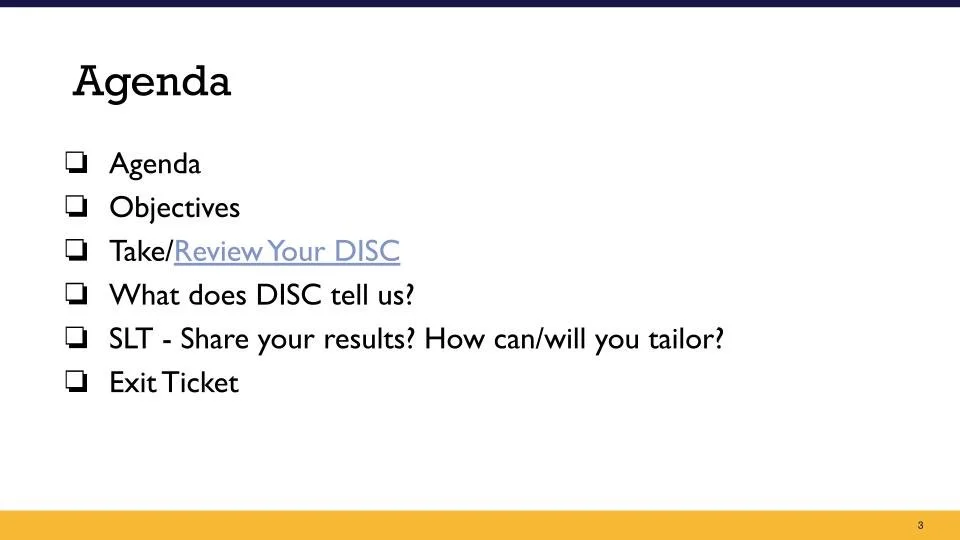
Example slide from the deck
A tracker for your whole team
Individual results are interesting. Team results are useful. The second file is a spreadsheet with three tabs that turn a pile of individual reports into something you can actually see.
The Overview tab holds the DiSC model itself, so anyone opening the file has the reference in front of them. The Sample Profile tab shows what a completed graph, intensity index, and classical pattern look like, which saves you explaining it twice.
The Tracker tab is the point. One row per staff member, with their segment number for each of the four dimensions and their classical pattern, plus a spot to link the folder where you store everyone’s full results. Once ten or twelve names are in there, the pattern jumps out. Some teams discover they have no high D at all and nobody is pushing decisions forward. Others find they are stacked with one profile and keep making the same blind-spot mistake.
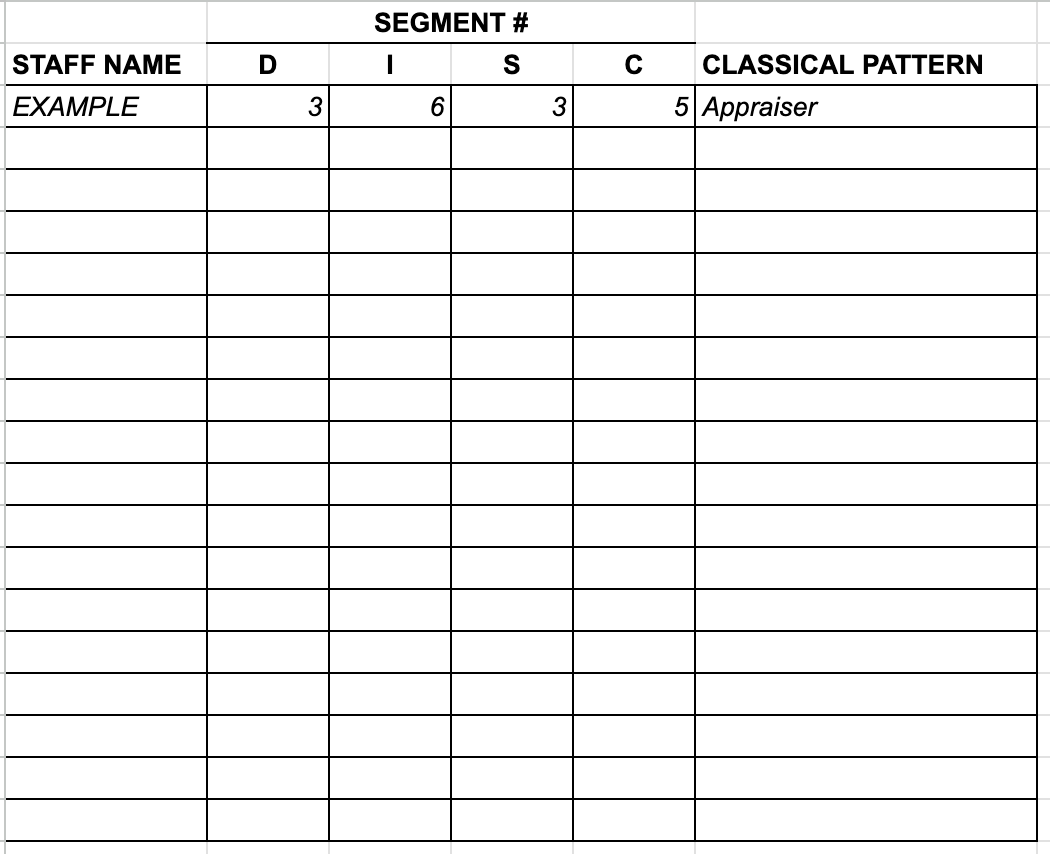
A cross-functional planning workbook
Knowing how your people work is only half of it. The other half is having somewhere for the work to live once it crosses department lines. The fourth file is the workbook for that.
The Project Outline tab is a single structured page for any initiative that touches more than one team. Chief owner, sponsor, project manager, who to go to with questions, objective, measurable end goal, departments involved, milestones, five phases from planning through post-launch monitoring, deliverables, budget, resources, risks, dependencies, and a communication plan.
The Task Tracker tab is the working list underneath it. Numbered tasks, status, departments involved, one named person responsible, a deadline, and a notes column. The Budget tab compares budget to actuals to forecasted spend to end-of-year variance, with a general ledger tab behind it for the detail. There is also a condensed snapshot tab for when you need the whole project on one screen with a green, yellow, or red status.
Most cross-functional work in schools falls apart in the same place. Everyone agrees in the meeting and nobody leaves owning a specific thing by a specific date. This workbook is built to make that impossible.
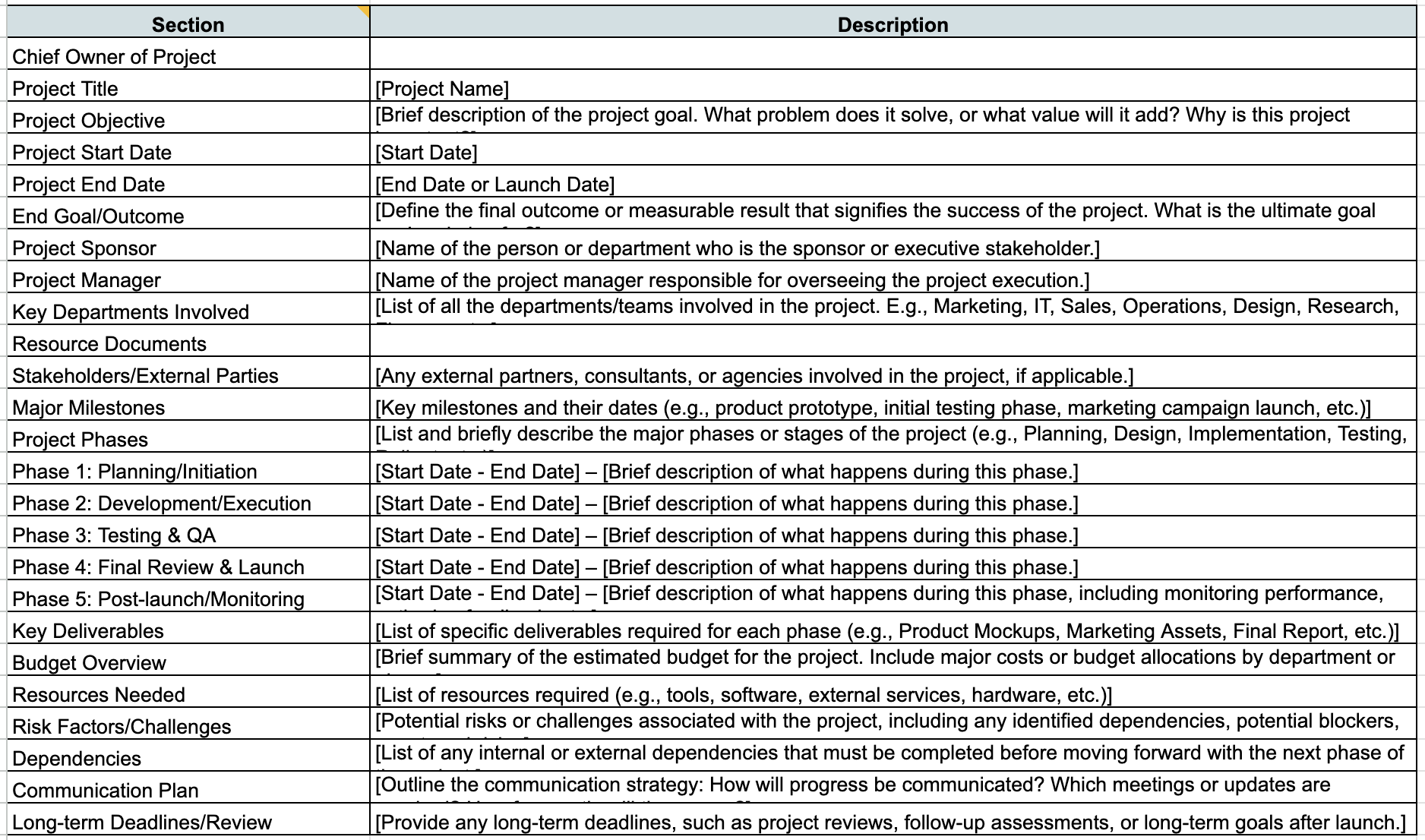
How to run this in one meeting
Have everyone complete an assessment before the meeting and send you their results.
Spend the first ten minutes on why you are doing this, framed around your core values and your students rather than around personality types. Spend the next fifteen on the model itself, using your own profile as the example. Give the middle fifteen to the share-out, with each person naming their profile, their strengths, and their challenges.
Spend fifteen minutes on the practice activity, where each person plans a real upcoming conversation with someone whose profile is opposite theirs. Close with the exit ticket. Afterward, log everyone into the tracker and keep it somewhere the team can see.
That is one hour, and it will change how your next twenty meetings go.
Moving beyond your leadership team
Kayleigh’s whole argument is about belonging. She wants students who walk into any room, including rooms they were never expected to enter, and know they belong there.
Adults model that or they do not. A leadership team where people quietly write each other off as too pushy or too slow or too fussy is teaching something, whether or not anyone says it out loud. A team that can name how they each work, and adjust on purpose, is teaching something else.
Download the free DiSC Leadership Toolkit
All four files come together in one folder: the slide deck, the team tracker, the example report, and the cross-functional planning workbook. Make a copy, put your logo and your core values on the first slides, and put a date on the calendar.
Start with your own profile. Everything else is easier after that.